


Sports betting is the new opioid crisis, former U.S. Surgeon General Jerome Adams warns.
“Our kids, especially our boys, are getting exposed and hooked early. And it’s ruining lives as surely as turning a blind eye to prescription opioids did,” Adams wrote on X.
If that sounds hyperbolic, Pennsylvania resident Ray Mikesell would like you to know about his son, Ray Jr., who developed a gambling addiction as an underage high school student through online betting platforms. That addiction followed him into his 20s, and on the verge of being evicted, Ray Jr. took his own life. Ray Sr. contends that his son’s financial strain and spiraling mental health state were directly related to his sports gambling addiction.
Ray Jr.’s story isn’t just a one-off. A growing number of studies are linking suicidal ideation and attempted suicide with problem gambling. The effects are seen most acutely among males ages 15 to 34. A 2024 Rutgers University study found that 28% of problem gamblers reported suicidal ideation and 20% had attempted suicide. More than one in four said they had engaged in non-suicidal self-harm.
This is, of course, just one significant negative side effect of sports gambling among an ever-growing list that includes addiction, debt, credit default, and anxiety.
The U.S. Supreme Court legalized single-game sports wagering in 2018, and since then 39 states and Washington, D.C., have followed suit to legalize some form of sports gambling. Online betting is permitted in all but six of those states.
Previously, prospective bettors had to go to physical locations, such as casinos, in order to place a bet, or have a bookie who would place bets on someone’s behalf. It was a long, somewhat difficult process that cost you more than just money. It involved time and effort and you couldn’t really do it anonymously.
But now with the proliferation of sports betting apps like FanDuel, Draft Kings and Bet 365, you can do it within seconds from your phone from the privacy of your couch by just pressing a few buttons. And if you lose, you can quickly reload your account to try and chase your losses. You can even place live bets as you’re watching a game.
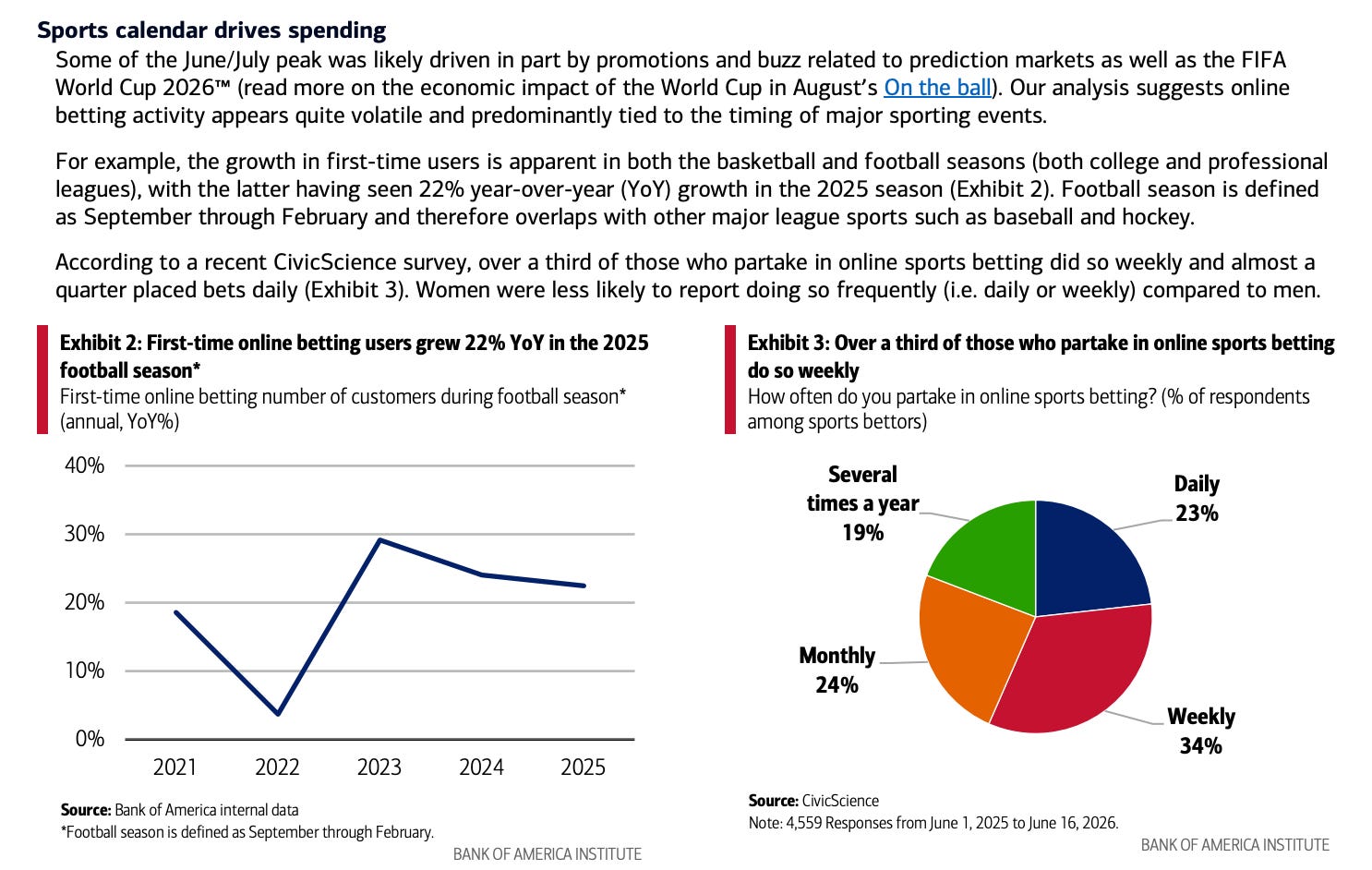
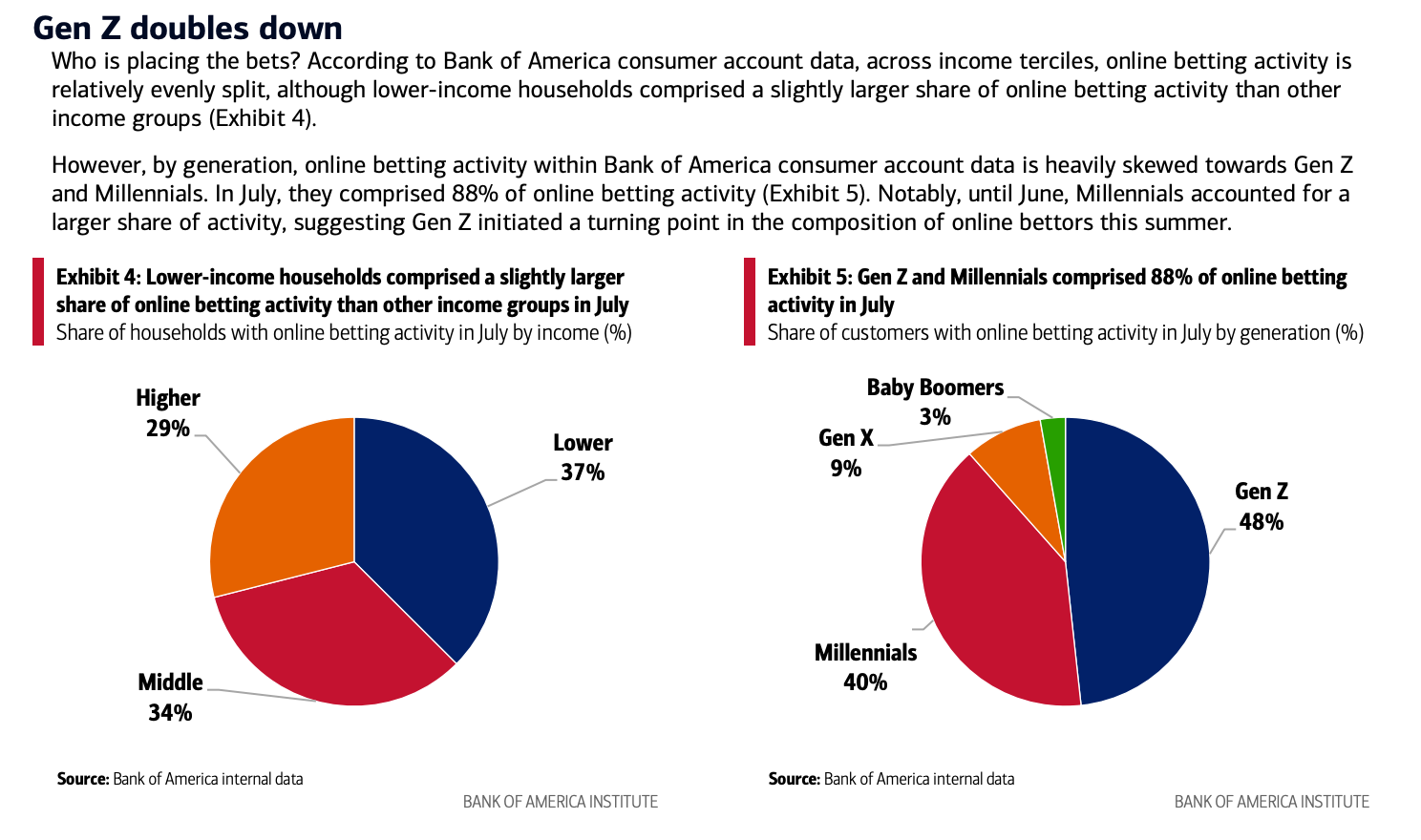
It’s never been easier to bet on sports, and people have never been more interested in doing so, data shows. According to 2026 Bank of America consumer account data, the number of online betting users increased significantly in the summer of 2026 thanks in part to the World Cup, with first-time users in June and July more than triple January levels. Millennials and Gen Z accounted for 88% of online betting activity in July.
I’m old enough to remember when Scott Van Pelt or other TV pundits would vaguely refer to betting, saying a score “might be significant to some” as a coy way to reference a point spread. For years, professional and college sports leagues as well as the media outlets that covered them shied away from directly involving themselves with gambling.
As author and historian Paul Putz explains in this podcast, for centuries gambling was associated with things like drinking, swearing and pre-marital sex. As Paul explains, many of the sports we enjoy, like basketball and volleyball, were created for and seen as an outlet for character and moral formation, and that necessitated guarding it from the potential ills of sports gambling that could not only sully the ethics of the athletes, but also the sanctity of the contests themselves.
“And pro baseball leagues and other leagues also thought it was good for business,” says Putz, who is an assistant professor of Christianity and Sports and the director of the Faith & Sports Institute at Baylor University’s Truett Seminary. “If you actually want to have a respectable middle-upper class audience, you need to keep some of the gamblers out. So these sports leagues really knew it was in their best interest to avoid associating with gamblers.”
But it’s no longer a taboo topic. Instead, it’s openly embraced, including by professional sports leagues that now openly partner with sports betting companies. Turn on just about any sporting event and you’ll see countless ads around the stadium and on the broadcast. Nearly every commercial break includes at least one advertisement for a sports betting app, often delivered in an exciting tone and promoting bonus bets or free money once you make a deposit.
Professional athletes and other celebrities, like comedian Kevin Hart and NBA star LeBron James, Taylor Lewan and Will Compton of the popular Bussin’ With the Boys Podcast, NFL legend Tom Brady and actor Jon Hamm are just a few who have appeared in commercials advertising sports betting apps.
The latest wrinkle to hit the gambling space is prediction markets like Kalshi and Polymarket, which Substack partnered with earlier this year to allow users to integrate prediction data into notes and posts. Brian Moritz at Sports Media Guy explains in detail why this particular partnership is so problematic. Most recently, actress Sydney Sweeney appeared scantily clad in an advertisement for Novig, another prediction market, which has brought new backlash from critics of the sports gambling industry’s aggressive marketing blitz over the last several years.
Until it shuddered recently, if you wanted to watch your favorite team, you likely did so on the FanDuel Sports Network. Plenty of broadcasts, including sports talk shows and newscasts, now regularly discuss odds, point spreads, over/unders, or player props no different than they would a player’s stats or a team’s record.
The normalization of sports betting is here. There’s no escaping it. It’s every bit as part of the fabric of sports as hotdogs are with baseball games or tailgating is with football. We’re to the point where it’s presented as merely an additional fun and exciting element to your sports watching experience that puts you in the action. But aside from hard-to-read fine print on ads, none of these companies or celebrities seem to be too concerned about the dark side of it all and the legitimate dangers people risk facing when they get too deep into it.
The Allure of Easy Money
It’s worth acknowledging that not every single person who participates in sports gambling faces some dramatic demise. Plenty of people have found a way to use these apps modestly and responsibly. To some, spending $10 or $20 sparingly on a parlay is no different than buying a coffee or dinner. There are also plenty of people who casually participate in things like March Madness bracket pools or fantasy football that may require a modest buy-in once or twice a year.
But for some people, sports betting has become a daily habit. While roughly half of Americans reported to U.S. News & World Report that their typical bet is less than $25, Americans made enough total bets to accumulate nearly $167 billion wagered on sports in 2025, marking an 11% increase from the previous year, according to the American Gaming Association. Furthermore, Americans spent nearly $17 billion on state-sanctioned sports betting in 2025, an all-time high.
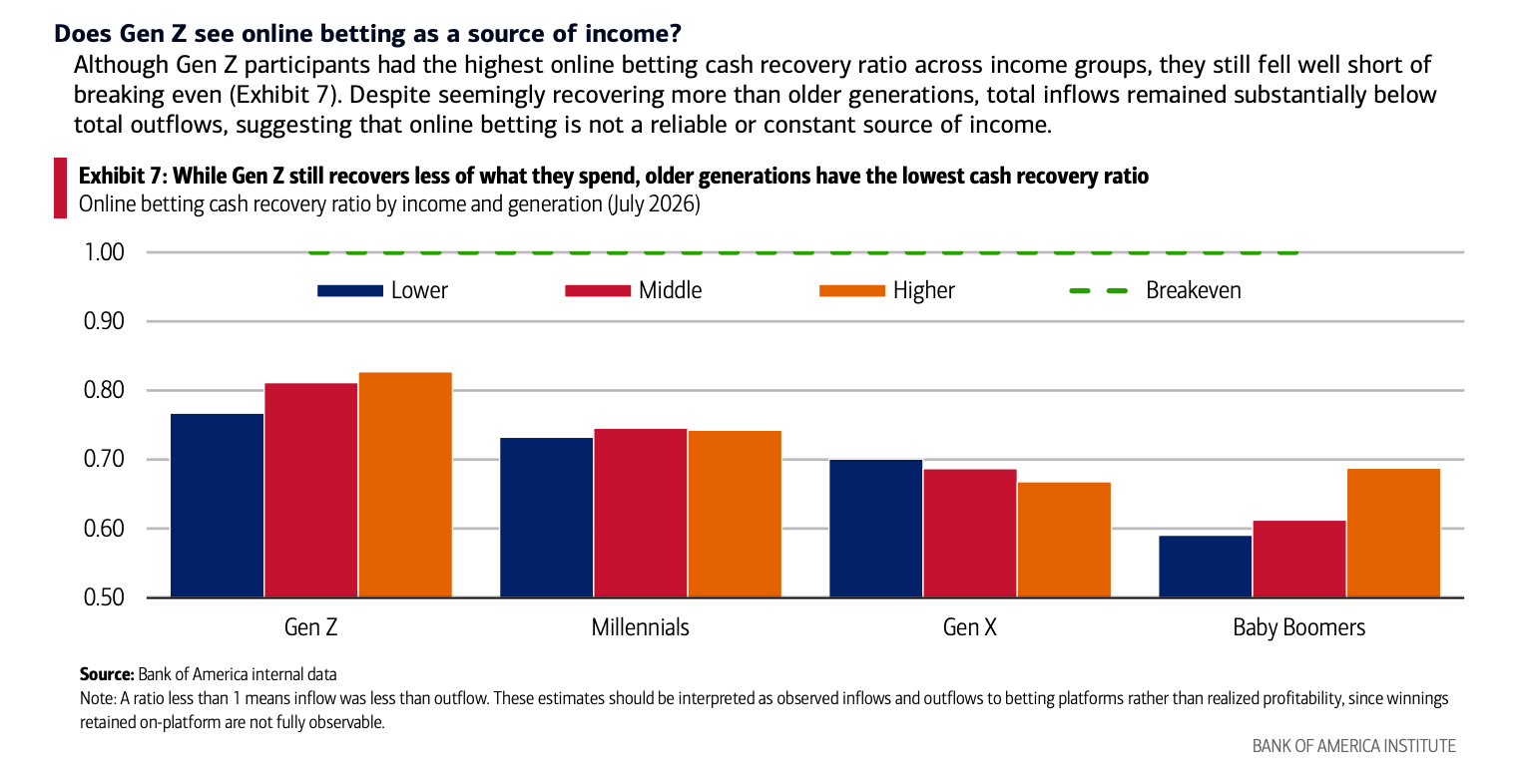
New data suggests a growing portion of young adults are turning to sports gambling or prediction markets — online platforms where people buy and sell contracts based on whether a future event will happen — as a way to make a living or at least supplement their income. The U.S. News survey found that 51% of respondents said they placed bets to try to help pay their bills, and 21% have made bets to cover their rent or mortgage.
Essentially, these demographics see sports betting as a way to make a quick buck. Placing a bet and hoping for a payout of hundreds or thousands of dollars is more attractive and seems easier and much quicker than working an actual job. If you win a bet, you can have the money in your bank account almost instantly.
But the reality is that some people are just going further into debt. That’s particularly concerning for young adults, and especially college students, who are likely already strapped for cash as it is. Perhaps it’s no surprise, then, that 19% of respondents to the U.S. News survey reported having outstanding debts directly related to sports betting. About 22% of respondents said they worry they can’t control their gambling, and 48% said they have other debts they attribute to sports betting.
But bettors are largely ignoring these realities as well as anti-gambling messaging. Polling shows that many bettors still believe certain gambling-related myths, such as that they’re be due for a big win after they’ve experienced a streak of losses. According to a recent poll from the Siena Research Institute, more people appear to be chasing their losses on sports betting apps than ever before — meaning when they lose, they immediately double down and make another bet in hopes of making back the money they lost.
Usage of prediction markets has grown drastically over the last couple of years. These platforms allow people to wager on a range of future-based topics like what the weather will be somewhere, who will win an election, or typical sports prop bets like game outcomes and player stats.
Some legitimize their use by comparing them to buying and trading stocks, which is a practice often encouraged by sound financial advisers when trying to build wealth. Data from Bank of America shows that Gen Z is twice as likely to consider sports betting as a form of investing. Across all generations, buying event contracts on prediction markets was more likely to be considered an investment than sports betting. But stocks are heavily regulated investments backed by real companies with legal transparency, whereas prediction markets often operate closer to gambling with lighter oversight and no underlying tangible value.
The swift rise of these platforms has been met with plenty of criticism about their predatory nature, leading to an investigation from the New York City Council into how Kalshi, Substack-backed Polymarket, Coinbase and Gemini Titan advertise prediction contracts to city residents. Specifically, the investigation “targets marketing that may be false, deceptive, or abusive, with specific concern for ads aimed at young people,” Yahoo! reported.
When I was a reporter for U.S. News, I covered a story about how some colleges were starting to partner with sports betting companies. In many cases, this included marketing materials being placed around campus and in athletic venues. Under some of these partnerships, these companies were able to advertise directly and indirectly to students.
At Louisiana State University, which signed a deal with Caesars Sportsbook in 2021, some students received an email prompting them to “place your first bet (and earn your first bonus).” This was sent to students who were under Louisiana's legal betting age of 21, and it led to a nationwide discussion about the ethics of these partnerships and the potential dangers of colleges marketing an addictive product to its students.
But younger teenagers continue to be exposed as well. Like Mikesell Jr. was, plenty of children are subject to incessant gambling marketing years before they’re legally able to do so through video games, social media, TV and even their own parents.
A 2026 national survey by Common Sense Media found that 36% of boys ages 11 to 17 had gambled in some form within the previous year, and nearly one in eight had bet on sports. Research also suggests that parents can play a role in facilitating underage gambling. Previous studies have found adolescents engaging in sports betting with parental supervision, while the Common Sense Media survey found that 23% of boys who gambled had been given permission by their parents to use their credit cards.
Jim Huh, a recovering gambling addict and counselor, told ESPN he’s worked with families with children as young as 11 who have sought treatment. He once saw a 14 year old who was six figures in debt.
“These are things that we’re now seeing that, years ago, we would probably never have seen,” said Huh, who works at GamFin.org, a financial consultancy for people suffering gambling harm.
The System Is Rigged Against Bettors
The majority of bettors are novices, meaning they likely have a rudimentary understanding of how sportsbooks operate and how the odds are created to help the house win. In other words, sportsbooks are in the business of making money, and they do so by intentionally setting odds that entice bettors to lose money. Even the promos or boosts they offer are meant to entice you. Though it may seem like it, they aren’t benevolent entities willing to give people free money.
You’re also competing against people who are quite literally professional gamblers and have insider information and can directly affect the odds you’re working with. On top of that, athletes and coaches — and even officials — are actively betting on the games in which they’re participating. There’s never a guarantee about the integrity of that which you’re betting on.
Just in the last couple of years, we’ve seen major gambling investigations involving star players in the NBA, MLB and NFL. Emmanuel Clase, an All-Star closer for the Cleveland Guardians, was caught deliberately throwing balls in order to hit prop bets. NBA players like Terry Rozier, Malik Beasley and Damon Jones along with Basketball Hall of Famer Chauncey Billups were just a few of the 31 people indicted for a massive gambling operation in pro basketball.
This summer, former college quarterback Brendan Sorsby’s career ended in disgrace following an investigation that revealed he had placed upwards of $90,000 in bets, including around 40 on his own team when he was the quarterback at Indiana University.
What This Means for Christians
Plenty of Christians enjoy sports. That means plenty of Christians are exposed to and are likely enticed by the idea of sports gambling. But many are wondering if it’s something they should be participating in. Over the past five years, Google searches for “Is sports betting a sin?” rose more than 5,000 percent over the previous five years, Common Good Magazine reported.
Collectively, Christians are relatively split on the issue. In a February 2025 faith and sports survey by Sports Spectrum, 42% of Christians surveyed said they had a positive view of “sports betting, particularly online sports gambling.” Only 22% felt somewhat or very negative about it. That means roughly 35% are neutral on the issue.
For the last three years, I was in that camp. When sports betting became legal in Kentucky in 2023, I was eager to download the apps and test out my sports knowledge. My friends and I excitedly grabbed up all of the free offers from the apps that matched your deposit with free bonus bets. I hit a couple bets out of the gate, including one for a rather large amount of money, and I was hooked. I rarely bet more than $5 or $10, and I was able to limit it mostly to Saturdays and Sundays during football season, but if I were to tally it up, I probably ended up hundreds of dollars in the red.
Losing a bet, especially by a small margin, deeply affected my mood to a level that started to concern me. At first it added a little intrigue to watching a game, but it had quickly become something that brought way more anxiety than enjoyment. So this summer I made the decision to be done with the apps and sports betting altogether.
Whether or not sports betting is a sin isn’t a question that’s easily answered with a yes or no. There’s some nuance involved because, like any sin, it requires digging into why someone is engaging with that behavior. What’s motivating them? Is it purely an entertainment outlet, or is it indicative of something deeper happening in their soul?
As Putz explained in the podcast, the first place to start is to consider that it’s a matter of wisdom. As Christians, we are called to be above reproach and exhibit wisdom in our moral and ethical decisions, which should then guide our behaviors. Knowing that athletes and others directly involved in the games are manipulating results, to continue playing that game and willingly put money at risk shows a lack of wisdom that can lead to other detrimental behaviors.
As was the case for me, many people — especially young men — are drawn to sports betting because their friends do it. Some see it as a social activity and almost a natural extension of things like bracket pools or fantasy sports in that it can serve as a common bond and conversation topic in group chats.
For men in particular, this can help foster a sense of belonging. For a demographic suffering from increasing loneliness, sports and the ancillary activities surrounding it like gambling can be a doorway into making quick friends and building a sense of connection. That’s why things like fantasy football or March Madness bracket pools are so popular. Even people who don’t follow those sports can still participate and engage in community and friendly banter with friends, colleagues or family members.
“I think there’s something fundamentally human that draws people into gambling, which again is the social aspect of it,” Putz says. “And that’s how God made us. So it’s that lure. The problem of course is with so much of sin is it takes something meant for good and it twists and distorts it, and it leads to destruction.”
There’s also a slight religious element to it. Some see their next bet as something that could be life-changing. When I first started betting, I came up one leg short of a four-leg parlay that would’ve paid close to $2,000. I was bummed, but it was a free bonus bet given to me from when I first downloaded the app. To my surprise, I checked the app a week later and saw my account had been credited with the exact amount I was supposed to have won if the bet hit. I double checked, and the app had just erroneously credited me with a win.
Perhaps out of naivety, I contacted the company to alert them of the issue. It was a lot of money and I didn’t know what would happen if I cashed it and then they realized it was an error. They emailed me back and told me I won and to keep the money. Emily and I now enjoy a good night’s sleep every night on our king bed thanks to those winnings.
But that was indeed a fluke experience. I didn’t even actually win. But for a while, I definitely believed that another big payout could be in my future and it kept me coming back for it. Like others, I was falling for the trap that hitting a big bet could solve some of my problems.
“So, again, it’s misplacing the desire for whatever is broken that we want to be made complete,” Putz says. “It’s misplacing that in something that isn’t going to fulfill and will actually take away.
“But I think if we can sort of name the desires and the real human needs that are met through gambling, then hopefully we can start to think about how we move away from these sorts of habits and behaviors.”
Honestly, bro… I’m just so excited you wrote something on this topic! I felt like my Sorsby series was good for a specific angle on this… But you are covering this in a really helpful way for all people!
The statistics are staggering.
And with “predictive markets” entering the chat pretending to be a gambling alternative disguised as an “investment strategy,” it’s only going to get worse.